
There are four of us. Digital employees do the rest.
A team that combines research and practice, and works the way it advises its clients to.
Team
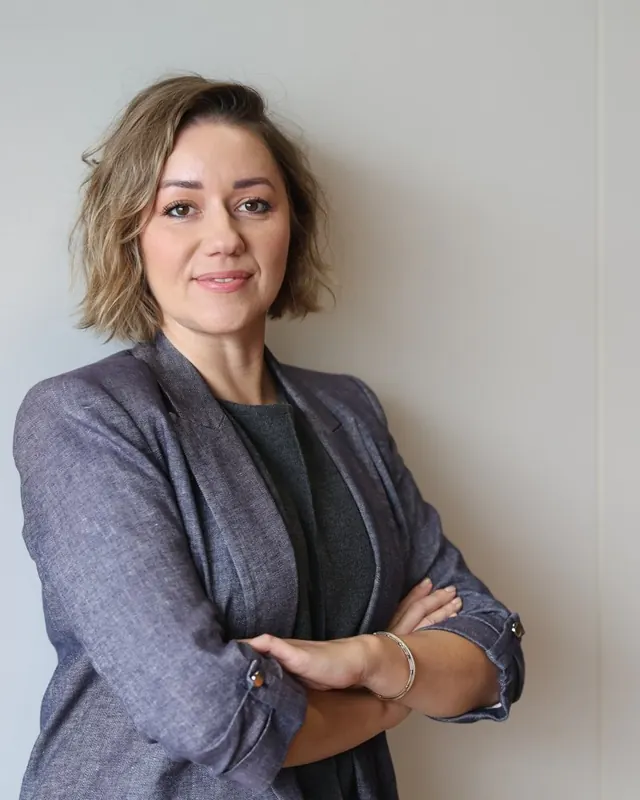
Stella Antolović
co-founder, marketing and sales
She has worked in marketing for more than fifteen years: in marketing in the IT industry, in a corporation on the launch of a new television service, as a consultant on more than twenty strategies, and she has co-founded two startups. Today she is a senior lecturer at Algebra Bernays University, and in her doctorate she researches how people experience conversations with AI. She is a member of COST HARPA, a European research network on privacy and AI, and takes part in AID, a research project on the influence of AI on decision-making. At 7Sense she defines how the digital teams talk to customers and leads marketing and sales.
LinkedIn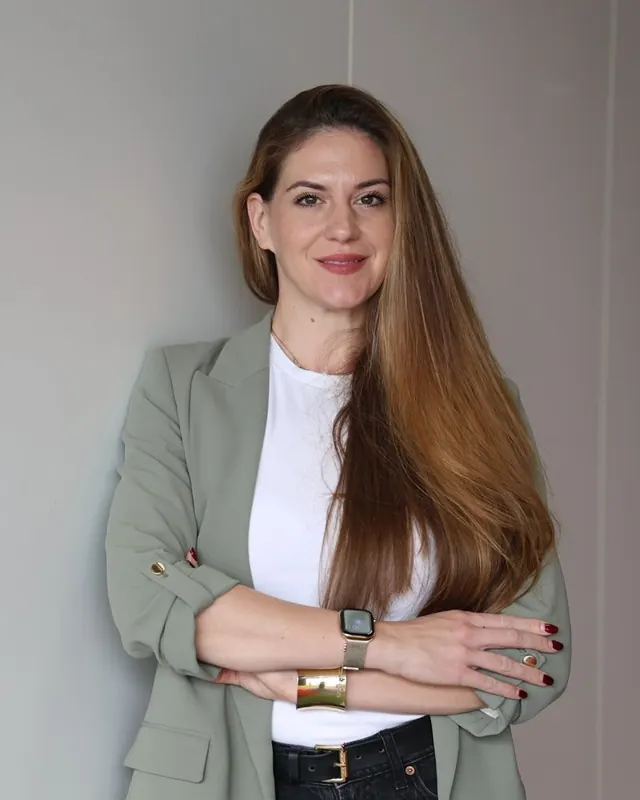
Rosa Stojnić
co-founder, product development and business analytics
She has been building digital products and services for more than fifteen years: in a corporation she was part of the team that launched a new television service, and she took an award-winning online store from idea to operation in five months. As a consultant she worked on IoT services, in the role of product owner and business analyst, and she has co-founded two startups. Today she leads large custom software development projects: systems with many connected applications, institutions and user groups. At 7Sense she leads product development and ties conversations to measurable business results.
LinkedIn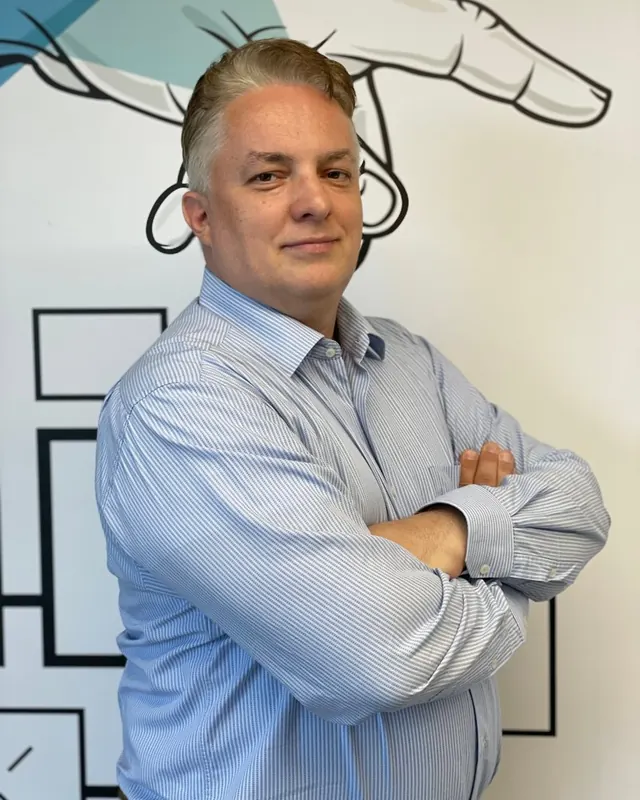
Bojan Mati
strategy consultant
For more than fifteen years he has led telecommunications and technology businesses in Europe and the Gulf countries. As director of an ICT company in Oman he took it through a tenfold growth in revenue, and for the largest systems integrator in the Gulf region he built an IoT practice from scratch. Today he leads strategic business development at Otech, part of the Omantel group, in digital transformation and AI. At 7Sense he leads strategy and business development.
LinkedIn
Antun Mihaliček
systems development and architecture
He has been developing software for more than twenty years. He started his career at Siemens, in international teams in Vienna and Munich, and then, as an architect and head of development teams, built online sales and IoT systems for large telecom operators in the region. At 7Sense he is responsible for the technical side of the system, from architecture to interface.
LinkedInTwo experiences, the same conclusion
In her research, Stella saw something we all feel but rarely name: a conversation partner that is almost human, but not quite, often puts people off instead of drawing them in. In corporations, Rosa watched knowledge exist in writing while everyone answered the same question differently. The conclusion is the same: the problem is not the technology, but that nobody has decided who does what, where the answers come from and how it introduces itself. Many chatbots on the market work exactly like that: they don't say clearly what they are and they answer from general knowledge. So we did it differently: digital employees that say openly what they are, have one clear job and do it measurably. They answer only from your company's knowledge, and from feedback they learn how to use it better.
How a conversation goes is not a matter of taste
This phenomenon has a name: the uncanny valley. It was described in 1970 by the Japanese roboticist Masahiro Mori.1, 2 Research shows that a feeling of eeriness in a conversation with a chatbot damages trust and loyalty3, and that a name and a face can even backfire when a customer arrives angry.4 The same humanness helps in a different situation5, so the question is not whether to have it, but how much and when. That is why we don't decide on the way of talking by feel, but by what has been measured. Which combination of personality and task builds trust is the subject of Stella's doctoral research, and we apply every finding to the teams Q trains.
Humans and AI together are not automatically better
106
When a human and AI work together, the result is on average weaker than when the job is done by whichever of them is better at it. That is what a review of 106 experiments showed.6 Together they are better only when the work is divided well. That is why we don't add a chatbot to existing work. First we work out with you who does what: what your people do and what the digital team does.
What research says about what we do
This research was done on robots, chatbots and AI assistants, because digital teams have not been studied yet. From it we take what holds for every conversation between a person and AI.
With work divided well, it helps people.
Among 5,172 customer support agents, an AI assistant raised productivity by 15% on average, most of all for the less experienced. Customers were more polite and asked for a supervisor less often.7
Trust brings the customer back.
Trust is the strongest single reason people return to a chatbot.8 And trust is gone with the first made-up answer, which is why our teams answer only from your company's knowledge.
Accuracy sells.
An accurate, credible and competent answer shapes satisfaction, and satisfaction shapes the intention to buy.9
Openness reduces unease.
When people know who they are talking to and how it works, the conversation partner feels less eerie and closer.10
A person has to be available in time.
In a study with 145 participants, customers reacted more aggressively when they found out only late, after the chatbot's mistake, that a person could help them.11 That is why Fixers, our customer support team, hand over to a person without delay whatever they can't solve themselves.
With AI, people look beyond their own field.
In an experiment with 791 employees of a large international company, R&D specialists on their own proposed technical solutions and commercial specialists proposed commercial ones. With AI, both groups proposed solutions that took both sides into account.12
Sources
- 1. Mori (1970), Energy; English translation in IEEE Robotics & Automation Magazine (2012)
- 2. Wang et al. (2015), Review of General Psychology
- 3. Rajaobelina et al. (2021), Psychology & Marketing
- 4. Crolic et al. (2022), Journal of Marketing
- 5. Adam, Wessel and Benlian (2021), Electronic Markets
- 6. Vaccaro, Almaatouq and Malone (2024), Nature Human Behaviour
- 7. Brynjolfsson, Li and Raymond (2025), Quarterly Journal of Economics
- 8. Nguyen et al. (2021), Sustainability
- 9. Akdemir et al. (2024), JTAER
- 10. Xu et al. (2023), Human Behavior and Emerging Technologies
- 11. Huang and Dootson (2022), Journal of Retailing and Consumer Services
- 12. Dell'Acqua et al. (2026), Organization Science
Support
The first team Q trained already works with customers, and we keep developing it through the Deep Tech accelerator programme of the Zagreb Innovation Centre, with the support of ZICER and the City of Zagreb. In the programme it goes by the working name Symbiont.
For the implementation of the project we received a grant from the budget of the City of Zagreb. The funds were awarded by ZICER, the Zagreb Innovation Centre.
“AI won't replace humans — but humans with AI will replace humans without AI.”